
Physical AI Research
Part of the Bumblebee project. The pipeline, and the benchmark behind it
BeeHand3D is our team's 3D hand-tracking and retargeting algorithm, built as part of the Bumblebee project. It takes egocentric video and returns 21 hand joints in 3D, then retargets them onto a dexterous hand. To check it properly we built a benchmark around it: 63 takes with motion capture ground truth, four published models for comparison, and the same IK solve applied to everyone's output. It comes out ahead on both metrics. Coverage sits next to every accuracy number, because one of them means very little without the other.
01 Output
Nothing is being solved in your browser. These are the joint angles BeeHand3D actually produced, replayed at 60 Hz on the same LEAP and Shadow models the benchmark scored. Drag to orbit, scrub to move through the take.
Unmodified playback of the scored trajectory.
02 Motivation
Egocentric video of people doing ordinary manual work is the biggest source of manipulation data anyone has. Getting a trainable signal out of it takes two steps, and both have to hold up.
First, find the hand and work out where its 21 joints sit in 3D. Second, map that hand onto a robot hand with different bone lengths, different joint limits, and usually one fewer finger.
Most hand pose papers stop after the first step, which is fair enough given what they set out to do. It is not enough when the output has to drive hardware. We kept hitting poses that scored well and then fell apart the moment they went through IK, so we started measuring both steps together.
Hands leave the frame. They blur, they disappear behind whatever is being held, and often they are gloved. A model that only answers on the easy frames gets a good average out of it, which is why we never quote one without the coverage behind it.
Twenty one joints in 3D, scored against motion capture after a per-frame fit takes out position, orientation and scale. This is the number the hand pose literature reports, and it is a reasonable one.
Solve that pose onto a dexterous hand, respecting its joint limits, then look at where the fingertips end up and how steady the trajectory is. Both hands here are sim assets, so this measures kinematic fidelity, not how a controller would track it.
03 Protocol
Sixty three single-actor takes across 18 everyday tasks, shot on our mocap stage. Ground truth is BVH mocap at 120 Hz, resolved down to 21 joints per hand.
Everything is scored on the head-mounted iPhone view at 1280 by 720, native frames, no cropping or upscaling. Each model runs its own hand detector. We thought about handing everyone the same boxes and decided against it, since that would have measured our detector rather than theirs.
PA-MPJPE refits rotation, translation and scale every frame, then measures joint distance in millimetres. It tells you whether the hand is the right shape. MPTPE runs the pose through IK onto a robot hand and measures in centimetres where the fingertips actually land, with one scale factor held fixed for the whole take. It tells you whether a robot could follow it. We report both and never average them, because where they disagree is usually the interesting part.
We push the motion capture itself through the same retargeting. It does not come out at zero. It comes out at 0.28 cm on LEAP and 0.20 cm on Shadow, which is what the robot's own kinematics cost before any pose estimation enters the picture. Nothing can beat that. If something appears to, it has stopped tracking the hand.
Human hands and robot hands are different sizes, so retargeting needs a scale factor, and picking a flattering one is an easy way to win a table. We sweep it from 1.0 to 2.0 in eleven steps and show the whole curve. The operating point in the tables is whatever minimises the mocap baseline, fixed before we looked at any model.
Error is only computed over the frames a source answered on, so answering less makes it go down. Every table here puts coverage right next to error for that reason.
04 Qualitative results
Drag the handle. To the right of it you are looking at BeeHand3D's 21 joints per hand projected back into the frame. To the left, the frame we fed it. Four takes from the mocap corpus are below; they cover the range of clutter and hand poses the benchmark contains.
The suit and the reflective markers are there because these takes were shot on our mocap stage, which is where the ground truth comes from. No model on this page ever sees the markers. They see the video.
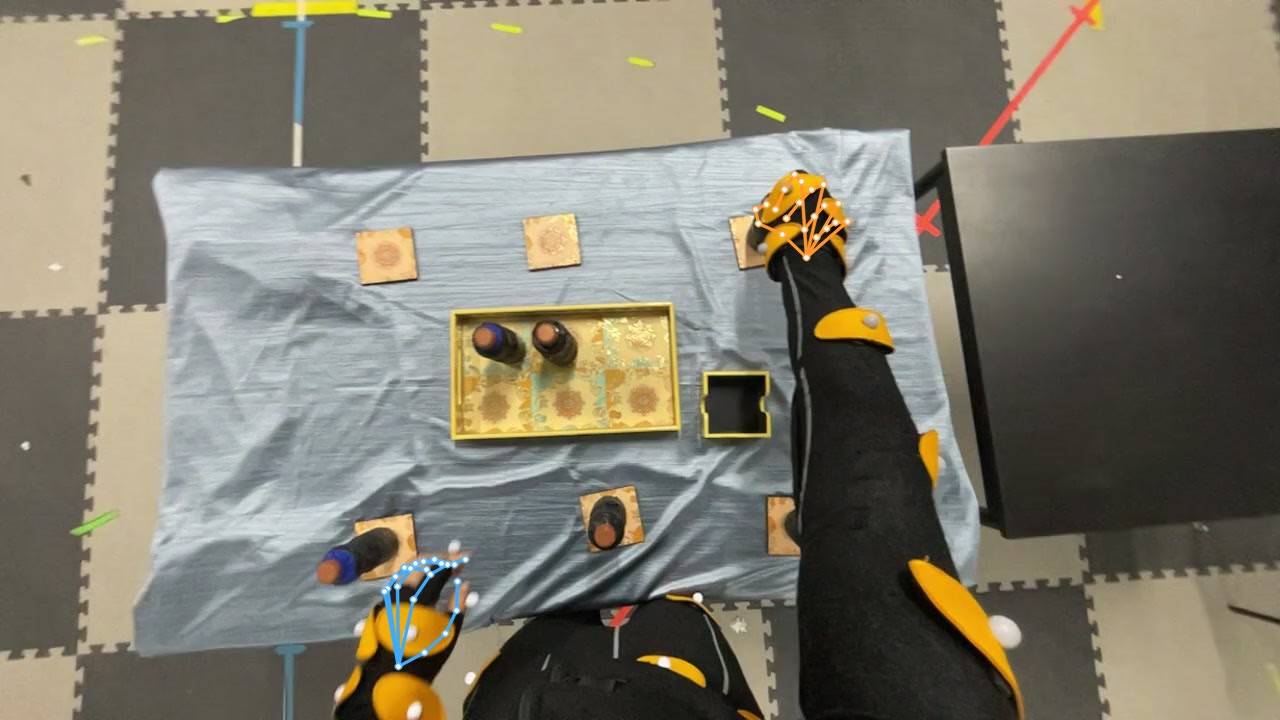
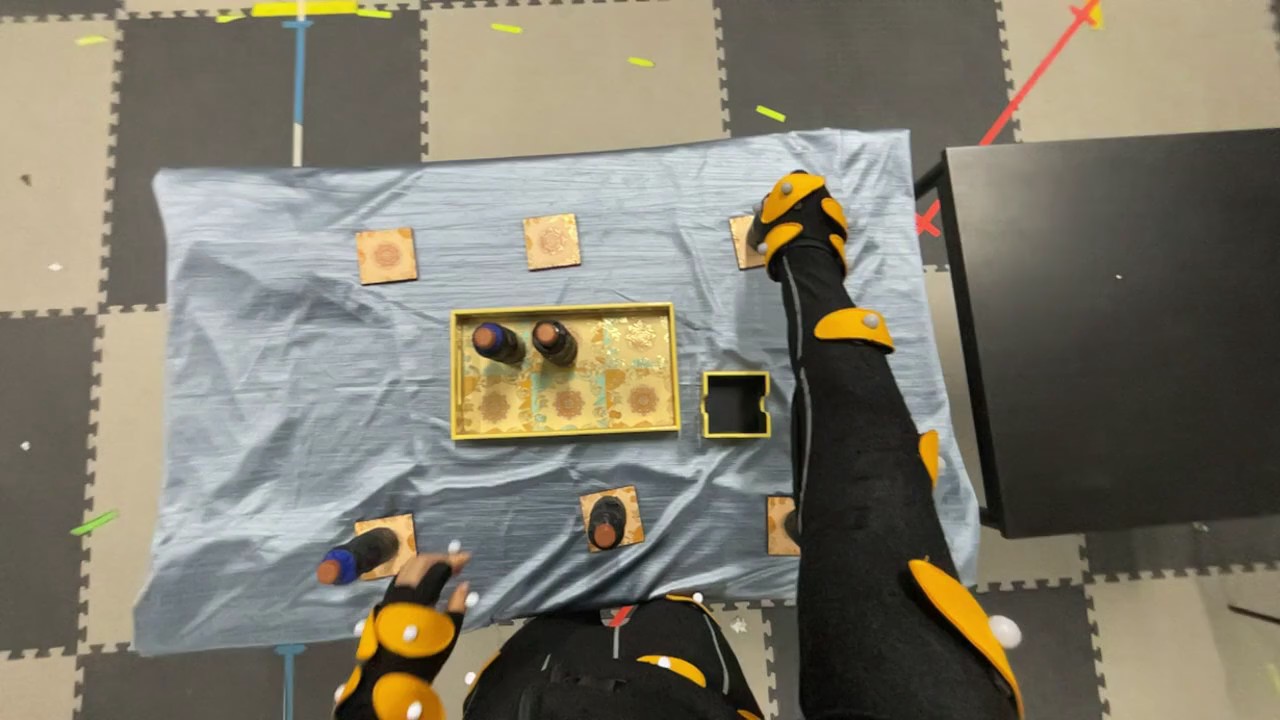
Left hand in blue, right hand in orange. Nothing is touched up: these are straight out of the overlay tool, at the frame rate and resolution the benchmark runs on.
05 Keypoint accuracy
Error only counts the frames a source answered on, so the two numbers have to be read together.
BeeHand3D has the lowest error here and the highest coverage. You cannot get that combination by being selective, which is why it is the pair we look at.
One clarification on coverage. BeeHand3D's detection rate is 99.2% of frames across all 63 takes. The 95.7% above is a stricter number: the share of ground truth hand instances that produced a usable scored answer. That is the one we quote.
06 Retargeting error
Every prediction goes through the same solver, the same frozen frame alignment and the same fixed scale factor. The number is how far each fingertip ends up from where it was told to go.
The dashed line on both charts is motion capture run through that same pipeline. Treat it as the floor rather than a sixth entry: the distance to it is what pose estimation costs on top of the morphology gap.
16 degrees of freedom, four fingers, scale factor 1.3
24 degrees of freedom, five fingers, scale factor 1.1
07 Sensitivity
Retargeting needs a human-to-robot scale factor, and quoting a result at one convenient value is the easiest way to oversell it. So here is the whole sweep. BeeHand3D is below every other source at every point on the grid, and its own best value, 0.58 cm at 1.16, is close enough to the operating point that the headline number is not resting on that choice.
08 Temporal stability
What an actuator feels is the third derivative of position, not the mean positional error. A trajectory can sit near the top of an accuracy table and still be unusable unless you filter it first.
On LEAP, BeeHand3D's fingertip jerk is 953 m/s³. HaMeR, only 0.30 cm behind on error, is at 12,906. WiLoR is at 15,564. Motion capture through the same pipeline is 289.
We apply no output filter to anyone. Smoothing here would turn the measurement into a property of whatever cutoff we picked, so the only smoothing in the loop is the solver's own temporal regularisation, which every source gets equally.
09 Scope and limitations
Global wrist pose is out of scope. Four of the five sources put the wrist at the origin by construction, and the corpus has no camera calibration, so there is no way to recover the world-to-camera transform. Everything here is measured in the hand's own wrist frame. Putting the wrist somewhere in space is an arm problem and a different benchmark.
The hands are sim assets. LEAP and Shadow are evaluated as sim assets under their declared joint limits. Nothing was actuated and no dynamics were simulated. These numbers say how faithfully a pose transfers to each morphology, not how a controller would track it.
Coverage is not detection. The coverage denominator counts ground truth hand instances, and the mocap suit happily keeps tracking the hand that has wandered out of frame. Nobody can find those hands. They count against every model the same way, so the column is comparable even though it reads low for everyone.
No collision term and no tendon coupling. Both hands are solved as free kinematic trees. Every source gets the same allowance, BeeHand3D included.
The keypoint table is the strictly paired one. It covers the 44 takes every source ran, so the ranking is not an artefact of which takes a model happened to get through. On the wider set no model moves by more than 0.18 mm and the order is the same.
Eighteen tasks, one capture setup. Household and light industrial work, one stage, one camera rig. It is a real corpus. It is not a representative sample of the world.
The floor is not zero. We are 0.34 cm above the LEAP baseline and 0.20 cm above Shadow, closer than anything else here, but still above. That gap is the part of the problem we have not solved yet.
10 Data
We run our own egocentric capture programme. The 63 mocap-synchronised takes behind this benchmark are a small instrumented slice of a much larger collection, recorded across household, retail and light industrial work.
Hand pose is one modality out of several. The same capture and annotation stack gives full body pose, object and scene segmentation, depth, contact and grasp events, gaze, temporal action segmentation and language description, all on one timeline and delivered in the schema a training pipeline expects.
BeeHand3D runs over the whole collection, not just the instrumented slice. Whatever we hand over comes with the protocol that produced it, which means a floor under each number and a coverage figure next to it.
The full results bundle for this benchmark is 101 MB and contains every table, figure and trajectory the page is built from. Available on request.